I had a recent interviewer ask me how I use AI.
My answer was broad, not specific. I have been using it for everything from Figma MCP to deep technical development, native Swift, Blender design, rebuilding my portfolio, and experimenting with interface prototypes. I could describe the tools and the work. I struggled to give one clear account of the process connecting them.
I wish I had one answer, but I didn't.
And for now, that's okay. But the process I am learning can be more efficient.
Halo is where that question becomes concrete. It is a sobriety-support product I am designing and building around private reflection, personal progress, and human connection. The work reaches from an iPhone interface to community experiences, voice studies, a guidance engine, and a physical bracelet. Each has taught me something different about working with agents.
Getting something native into my hands
Halo already existed as an Expo/React Native app before the SwiftUI migration. Figma was involved early, too. This wasn't a clean journey from code to design. I moved between them, sometimes productively, sometimes letting the implementation get ahead of the decisions.
The September native work translated navigation, state, storage, forms, animation, and haptics into iOS. Working in SwiftUI made questions tangible: how a sheet opens, where a keyboard leaves space, what survives a relaunch, whether a control remains reachable with larger text.
But functioning screens could still lose the design. A September 23 audit found decorative rings crossing form labels on compact layouts, welcome typography drifting from the reference, and missing-image states that felt unfinished. Another pass found that transparent padding made a wordmark requested at 140 points appear roughly 85 points wide. The original artwork was right. Its implementation was making it look wrong.
Those details are easy to accept when the next feature is already being built.
Together, and the difference between presence and a connection
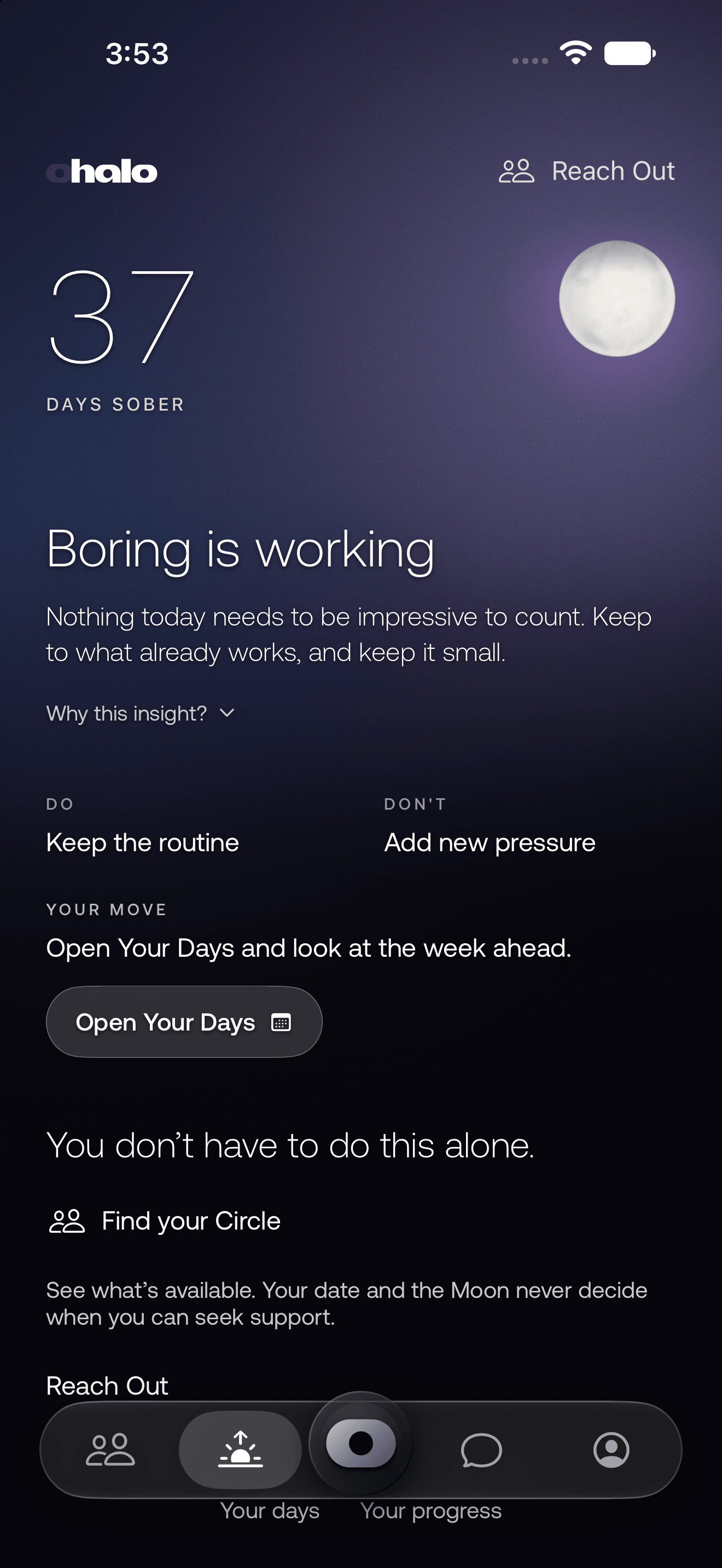
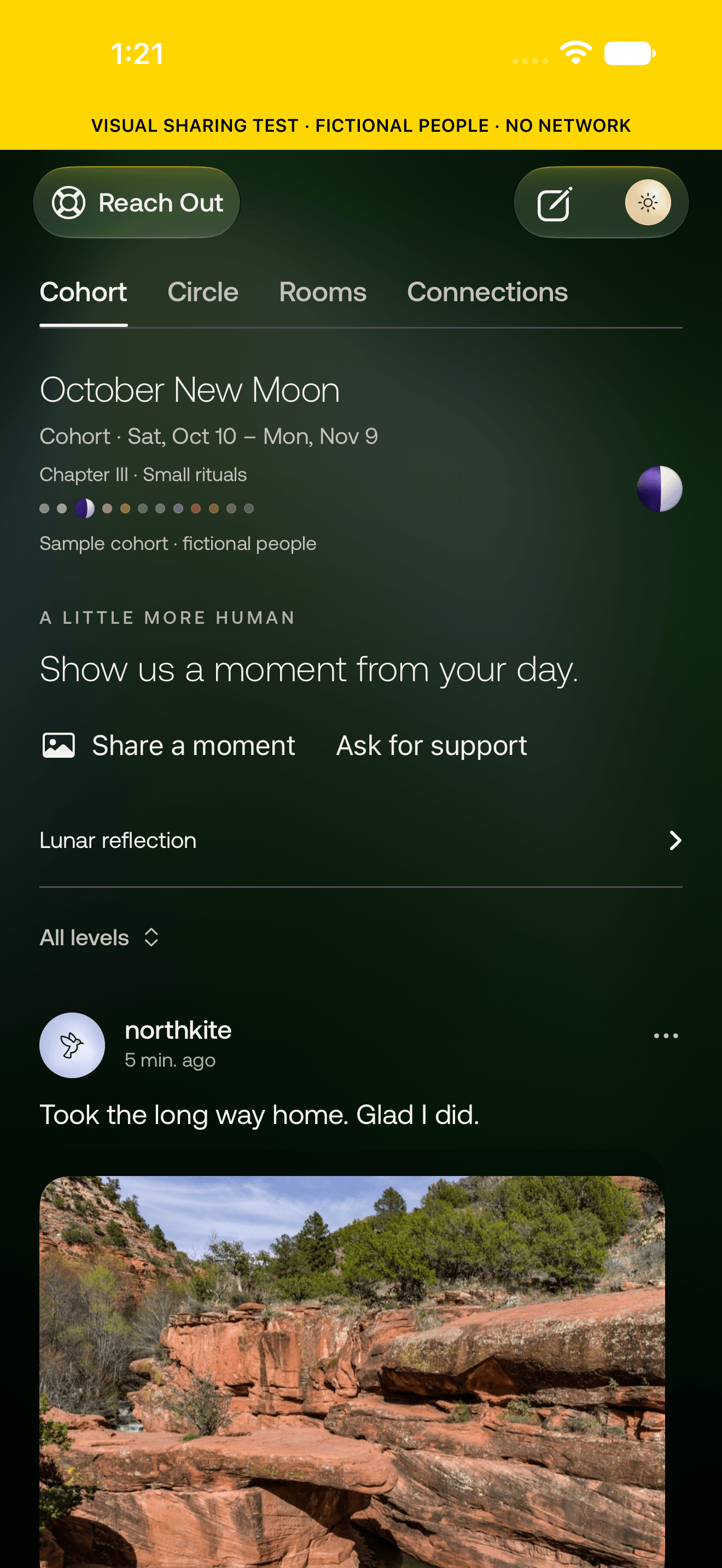
The social work forced clearer product decisions. Together became the broader community destination; Circle became the smaller space with explicit membership. Posts, replies, reporting, blocking, and permissions needed to support that distinction. A shared visual language did not mean they should become the same experience.
Voice brought another kind of design work. The Human Audio study explored a crescent that responded to microphone amplitude through light and form, alongside clear mute and connection states. I wanted presence to have a visual character without making the controls mysterious.
Then real microphone activation crashed, despite the injected-driver tests passing. The audio callback had inherited the wrong execution context. After the fix, the tests passed and I confirmed that simulator microphone input responded, settled in silence, and no longer crashed.
That was a meaningful milestone. It was also a local microphone study. The later LiveKit voice infrastructure remained gated, with genuine two-person audio still unqualified. A convincing room, a responsive microphone, and two people actually hearing each other are separate achievements.
The bracelet made time physical
The Year One bracelet concept gave progress another form: twelve monthly natural stones, with Opal at Month 12. The imagery was frozen on October 3 so the work could move toward feasibility and the core product.
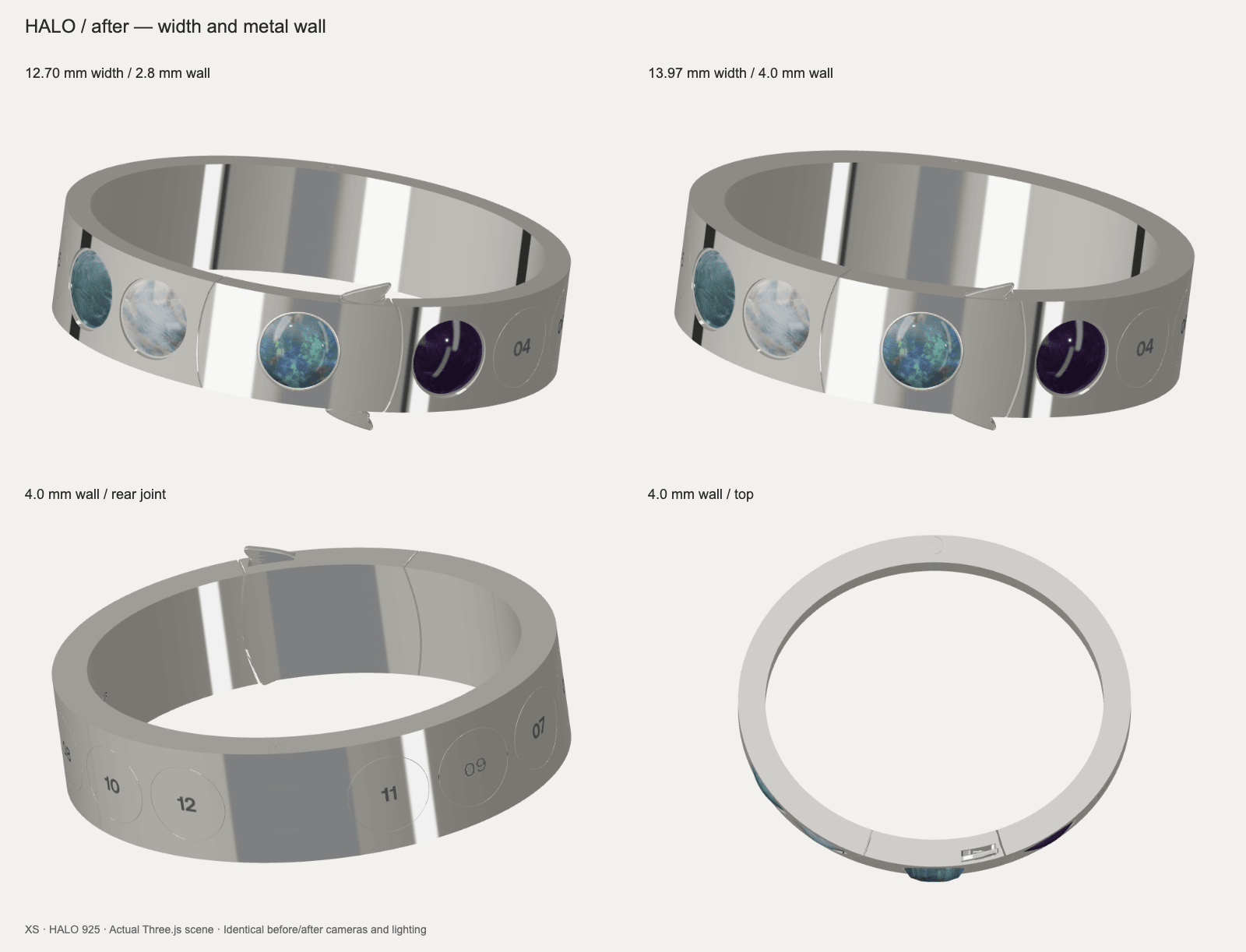
Later physical studies explored different closures, including Angel Wing and Center Press. Interactive models made it possible to inspect release gestures, materials, band widths, and wall thicknesses. These were separate explorations, not one settled manufacturing specification.
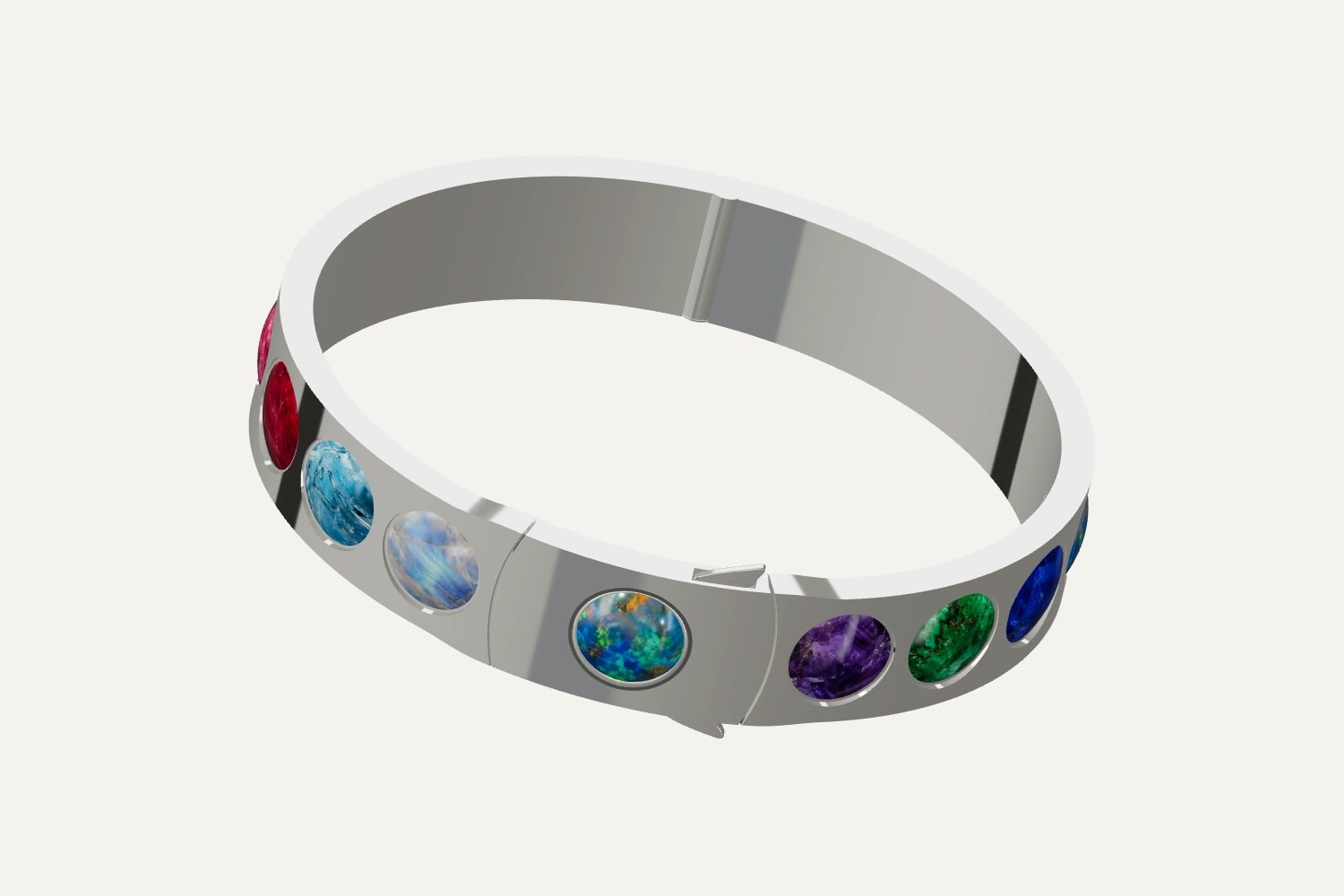
A correction to the model kept the band continuous across its width and thickness options. Hundreds of geometry checks passed, while opening the rear joint still revealed interference. Code helped expose the problem. Passing checks on the closed shape did not resolve the mechanics.
Open the bracelet process note
The October 17 uniform-profile study recorded 553 profile checks across 72 configurations. Its report still identified rear-joint interference during opening. The measurements describe generated geometry, not manufacturing tolerances.
Source record: Bamboo, docs/uniform-profile/README.md, October 17. The earlier Year One decision is recorded in docs/HALO_I_PRODUCT_SYSTEM.md, September 29 with the October 3 imagery decision.
An engine still needs an experience
Astro V4 took the technical work much deeper. The experimental engine combines on-device astronomical calculations, explicit goals, authored symbolic interpretations, consent, and an explanation of why a reflection was selected. It makes no runtime AI call. Astronomy and interpretation remain distinct; neither establishes a prediction about sobriety.
The difficult parts included missing birth times, ambiguous placements, and daylight-saving transitions. They also included deciding when the interface should say less.
A full-year simulation ran the actual calculation code across 365 dates and twelve goals, without birth information. Only 345 of the 4,380 date-and-goal cases qualified for the narrow V4 reflection catalog. The review also found repetitive actions and occasions when adding another suggestion conflicted with the existing invitation to rest.
That changed what the experience should ask of someone. The deeper reflection belongs behind an optional disclosure, with its reasoning available and an honest empty state. A working engine doesn't automatically deserve another card on Today.
Figma gives the decisions a home
I would generally start a visually ambitious native app in Figma now. SwiftUI remains valuable for exploring behavior, but I want a coherent direction before implementation convenience starts choosing the product's appearance.
October's Halo design system formalized Foundations, Components, Patterns, and screen references. Some were extracted from working native code. Figma became a place to consolidate and question the system, with MCP connecting that reference to agent-assisted implementation.
The connection still needed judgment. Halo's type roles specify Supermax artwork for the wordmark, Catalogue for editorial work, and Aeonik for the interface. Native already bundled Aeonik, while the Figma automation environment rendered substitute fonts marked as pending. Connecting the tools hadn't made the typography equivalent.
The integration extended existing spacing and type primitives while preserving native materials, Dynamic Type, and original art. On October 28, another visual pass restored forest-green Together, violet-black Today, and a smaller moments area. The hierarchy still needed a designer after the flows worked.
There is an older essay here called Still in Figma?, filed by an agent, that argues for getting beyond the mockup. I still value that impulse. Building Halo has made me less willing to treat the picture as a disposable step. It is a useful place to make decisions before they become expensive habits in the code.
Inventive UX
I admire inventive UX. Familiar patterns have value, but I don't want every product to feel assembled from the same Mobbin references. An interaction or composition should have room to belong to the product it serves.
Originality is difficult. Its practical value isn't always obvious, and unfamiliarity can create friction. The interesting work is finding something original that makes an experience clearer, more expressive, or more meaningful.
The tools to explore those possibilities have never felt more accessible to me. Generating an interface is easy compared with inventing a meaningful experience. I have been guilty of letting implementation lead. Still learning.
Where I am today
As of October 28, Halo has reached internal TestFlight. The October 27 Build 18 record confirms processing and availability to two internal testers. The subsequent design-system and personalization work is newer local development. Voice, physical hardware, and the experimental V4 presentation each have further qualification ahead.
My next step is a more disciplined loop: establish the experience in Figma, use native prototypes to answer specific interaction questions, reconcile what I learn into the shared system, and test the result in the environment where it matters. That is the efficiency I want: fewer decisions made accidentally, and fewer things to undo.
The next time someone asks how I use AI, I want to spend less time listing tools and more time explaining a decision I made with them.
Open the dated build notes and sources
- September 23–28: native migration, Figma comparison, and original-art corrections. Records:
MIGRATION.md,FIGMA_AUDIT.md, andBRAND_INTEGRATION.md. - October 20: Human Audio, commit
53ff4b8. The corrected run recorded 111 unit tests and six UI scenarios, followed by a user-confirmed simulator microphone check. No remote audio qualification. Record:docs/human-audio/VALIDATION.md. - October 27: Together/Circle separation, commit
57f3785. Build 18 ata2d4a76reached internal Testing. Genuine two-person communication qualification remained outstanding. Record:docs/release/BUILD_18_CLAUDE_HANDOFF.md. - October 28: Day One tutorial
c50ef36; typography and tokens6a668b2; visual restorationf72f5e3. Integration recorded 26 unit/layout and seven UI checks; the later restoration recorded 25 unit and six UI checks. These cover different revisions and local workflows. An invalid-frame runtime warning remained unresolved. Records:day-one/VALIDATION.mdanddocs/FIGMA_SWIFTUI.md. - Astro V4: isolated source
ac090c5; the integrated personalization handoff is6a9d982. Ordinary Moon retains V3. V4 presentation requires an isolated Debug review; a unified daily reflection remains future work. Records:docs/astro-v4/qualification/year-study/README.mdanddocs/daily-guidance/PERSONALIZATION.md.
The Halo design system is the visual reference. The records above establish dated milestones, not fresh certification of every current branch. The Together sample landscape is Bell Trail by Deborah Lee Soltesz / US Forest Service, CC0 via Wikimedia Commons, used in a labelled test fixture.