The best piece of music technology ever made fit in the little watch pocket of a pair of jeans, held a thousand songs, and shipped with a sentence instead of a spec sheet.
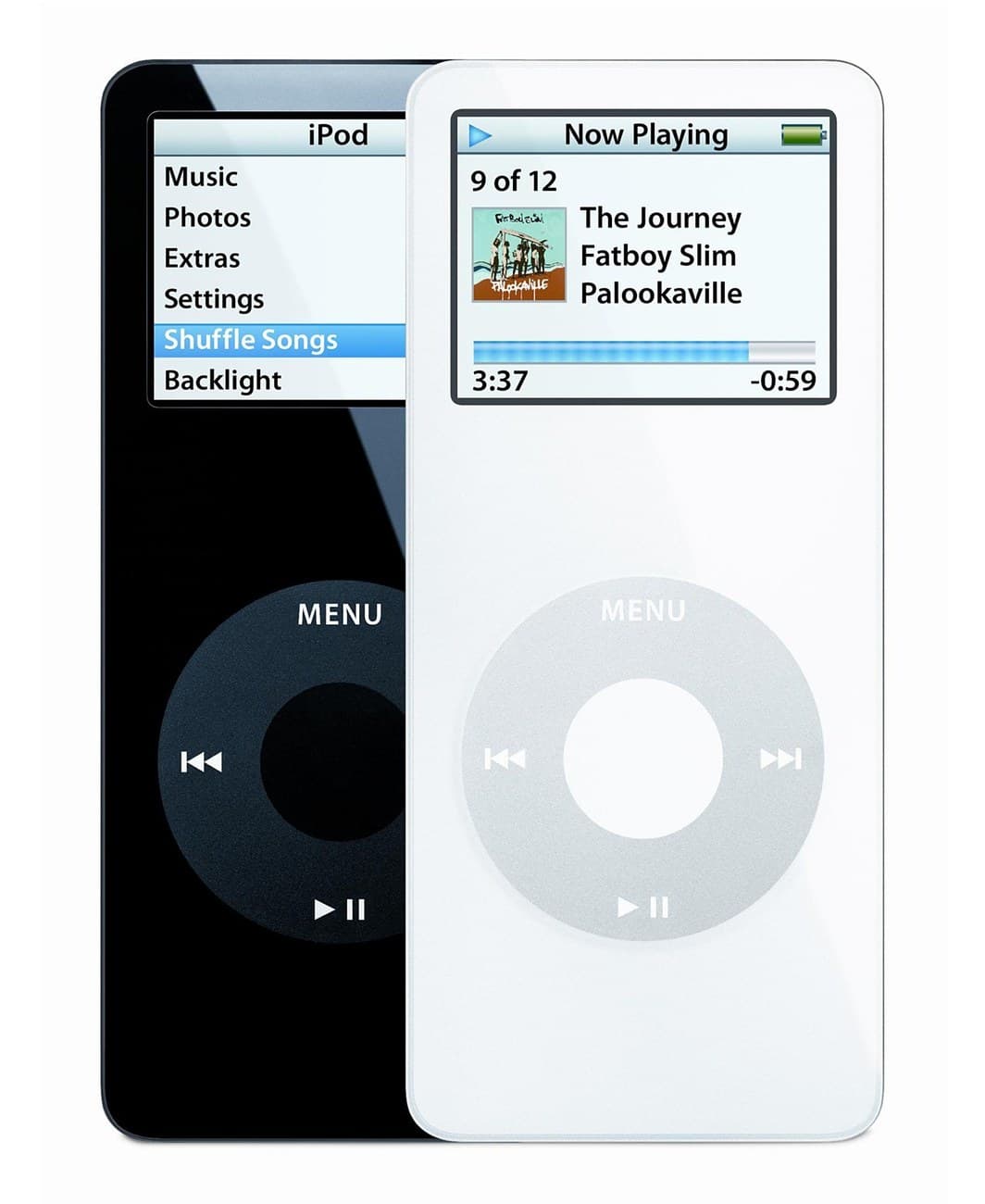
"1,000 songs. Impossibly small." Famous last words from my ex. Just kidding. Read it again. There is no megahertz in it, no codec, no capacity in gigabytes. There is a number you can feel and a contradiction you want to hold in your hand. The whole pitch is a sensation. That was the trick, and almost nobody has pulled it off since.
I want to be careful not to turn this into nostalgia. Nostalgia is lazy. The nano deserves an argument.
Constraint was the feature
The nano could not do very much, and that was the point. The first one held two gigabytes. You had to choose what came with you. Choosing is a creative act; infinite libraries quietly removed it. You loaded it on purpose. You curated, in the original sense, before the word got flattened into a verb for arranging other people's work. A thousand songs is not a library. It is a self-portrait that happens to be playable.
Streaming gave us every song ever recorded and, in the same motion, made each one weigh nothing. When the catalog is infinite and free, no single track can cost you anything, so no single track can mean very much either. The nano made music scarce again on purpose, and scarcity is where meaning likes to live.
The wheel knew where your thumb was
The click wheel is the most underrated interface of the century. You did not look at it. Your thumb learned the speed of the list, and the list learned the speed of your thumb. It was the rare control that got faster the more you trusted it. Touchscreens are more capable and less intimate. There is no muscle memory in glass.
Shuffle, on that device, was not a feature you tolerated. It was a way of listening. You handed the machine your thousand chosen songs and let it surprise you with your own taste. That is a strangely modern idea: a system that knows only what you gave it, recombining it into something you did not expect. I think about that a lot.
What it understood that the cloud forgot
Here is the part that keeps me up. The nano treated your music as yours. It lived in your pocket. It worked on a plane, in a basement, at the end of the world. The songs were objects you owned, arranged the way you arranged them, and the device was a humble glass case for a collection you had made.
We traded that for access, and access is genuinely better in almost every measurable way. But something unmeasurable left with the object. The feeling that your library was a place. That it was tended. That it remembered you because you had built it by hand.
That feeling is most of what I am trying to put back, somewhere else, by other means. Not the hardware. The relationship. A collection that is legibly, stubbornly yours, that compounds as you add to it, that knows what you gave it. The nano had it in 2005, in white plastic, for a few hundred dollars, with a sentence for a manual.
Impossibly small. We should have paid closer attention to the second word.