Open almost any music app and press play.
The song changes. The screen barely does.
There is a square of artwork, a title, a progress bar, and a row of playback controls. Sometimes there are lyrics. Sometimes there are comments. If we want a richer visual world, a conversation, a piece of history, or a reason to gather, we usually leave the music and open something else.
This interface is so familiar that it can feel like the natural shape of digital listening.
It is not. It is the shape of a particular problem being solved.
Streaming services solved access. They made an extraordinary amount of music available on demand, on almost any device, for a predictable price. They reduced the distance between wanting to hear a song and hearing it to almost nothing. That achievement changed music, and it should not be diminished simply because it is now ordinary.
But distribution became confused with experience.
For roughly fifteen years, software for listening has been organized around the same compact transaction: choose a recording, begin playback, move on. The catalog grew. The recommendations became more sophisticated. The player itself stayed mostly still.
We learned how to deliver every song.
We did not spend nearly as much time asking what a song could become once it arrived.
A song is already a world
Songs have never been only files.
They hold places, people, visual languages, private references, unfinished versions, and the conditions under which they were made. A release gathers photography, typography, performance, memory, clothing, choreography, rumor, and community around a few minutes of sound.
Most of that world disappears inside the player.
The recording survives, which matters most. But the listener is asked to meet it through an interface designed to treat millions of other recordings in exactly the same way.
There is a useful reason for that uniformity. A universal player has to be dependable. The play button should work every time. The queue should be understandable. Nothing should interrupt the music unless the listener asks for it.
The mistake is not the universal player.
The mistake is assuming it must be the final form of every listening experience.
Imagine that a song begins and, instead of watching its artwork remain motionless, you enter a place shaped by the recording.
The first verse reveals a page of handwritten lyrics. A sound in the left channel leads to the original field recording. When the chorus arrives, moments contributed by fans appear. They do not sit in a comment feed below the work. They arrive at the emotional point to which they belong. A door becomes visible during the bridge. Behind it is the demo that existed before the lyric changed. The room opens only after the final note.
None of this needs to turn a song into a game. It does not need to compete with the recording, reward constant tapping, or make stillness feel inadequate.
The interface can be quiet.
It can listen to the music with you.
The important change is temporal. A song experience does not sit beside the audio as a collection of extras. It unfolds with the audio. The song becomes the clock, the score, and the sequence of the experience.
At 0:00, a world can open. At 0:47, it can remember something. At 2:13, it can let other people in.
Listening becomes participatory again. Not because every listener must perform, but because there is once again somewhere to go.
Every artist deserves software
An artist today may have a presence in dozens of products without having a true place of their own.
Their music lives in a streaming service. Their audience lives in a social feed. Their tickets live in one marketplace, their merchandise in another, and their messages inside systems whose rules can change without them. A link page can connect these destinations, but it cannot make them feel like one world.
The artist has an identity. The software keeps dividing it into accounts.
For a long time, the obvious alternative was unrealistic. A dedicated artist app meant separate native products for iOS and Android, specialized teams, store review, release management, device testing, and a permanent maintenance obligation. That level of investment can make sense for a global service used every day. It rarely makes sense for an individual artist, especially when every artist would need to repeat it.
I recently wrote that the future was not in a mobile app. Now I am saying every artist deserves an app. Those ideas only contradict each other if an app must mean a destination sealed behind an app store.
An artist app can begin as a link. It can be useful before anyone installs it. It can appear in the moment a fan asks for it, then earn a place on the home screen instead of demanding one in advance.
Progressive web apps quietly changed this equation.
A PWA can open from a message, a search result, a QR code, or a social post. In supporting browsers and operating systems, that same experience can be installed, given an icon, and launched from the home screen or dock in a standalone window. It can support web commerce. It can change as the service changes rather than waiting for a fan to find an update in a store.
With permission, it can also support notifications. Apple brought standards-based Web Push to Home Screen web apps on iOS and iPadOS in 16.4, extending a capability already available elsewhere on the web. The exact installation path and the surrounding capabilities still differ by browser and platform. They should be designed as progressive enhancements, not treated as guarantees.
That limitation matters.
A PWA is not a universal replacement for a native application. Native software still has advantages when an experience depends on deep operating-system integration, intensive background behavior, specialized media pipelines, or platform-specific hardware. The web remains uneven at its edges, particularly inside in-app browsers.
But an artist app has a different center of gravity.
It needs reach. It needs a direct path from a shared link into an experience. It needs to work across many kinds of devices. It needs commerce, identity, media, and a respectful way to invite a fan back. It needs to improve continuously without requiring each artist to finance two permanent application teams.
For that job, the web is the right starting place.
The strategic advantage is not that a PWA can do everything. It is that one artist-controlled environment can be immediately reachable, broadly usable, and optionally installable. The relationship can begin on the open web and deepen without being forced through a centralized distribution gate.
The technology alone does not guarantee artist ownership. That has to be expressed in the architecture and the terms. Who controls the identity? Who approves the media? Who can reach the audience? Where does commerce take place? Can the artist take their information with them?
A PWA makes independence economically plausible. The product built on it has to make that independence real.
The PWA is not just a website wearing an app icon.
It is becoming a plausible operating environment for an artist.
The foundation that exists
Casset has made the first, deliberately small part of this idea real.
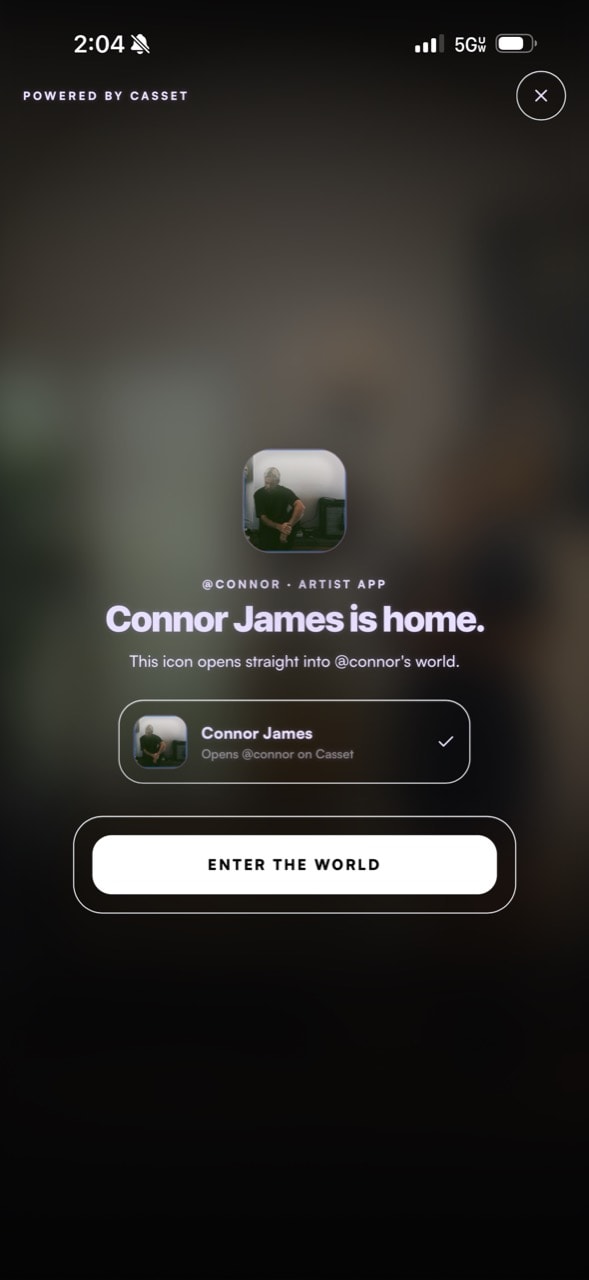
Today, an artist's Casset world can be given a place on a fan's home screen and opened directly into that artist's world. It is an early foundation, not the complete system described in this essay. Casset is not yet an open developer marketplace, and the full range of interactive song experiences imagined here does not exist today.
The distinction is important. A vision becomes less credible when the future is written in the present tense.
What exists now proves a narrower point: an artist-specific application surface no longer has to begin with a custom native build. A fan can install the relationship, not only the platform.
What we are building
Casset's product is being shaped around four related primitives.
The Profile World is the artist's living environment. It is not a static biography and list of links. It is the place where an audiovisual identity can accumulate.
The Hook Object is a doorway into that environment. It should feel like a living audiovisual object, never a generic preview with decoration placed around it.
The Release Ritual gives music a sense of time and arrival. A release is not merely a database update at midnight. It is an occasion people can anticipate and enter together.
The Listening Room gives that occasion social energy. It is not generic chat attached to playback. It is a gathering whose behavior is shaped by the music and the moment.
These are not four products competing for attention. They are four scales of the same idea: identity, invitation, occasion, and presence.
The next stage of Casset is to make this foundation more expressive while keeping it coherent. Profile Worlds should become deeper and more atmospheric. Hook Objects should carry more of a song's motion and feeling. Release Rituals and Listening Rooms should make collective listening feel intentional rather than noisy. The tools artists use to create these environments should feel like directing atmosphere, not editing shader parameters.
Underneath those surfaces, Casset is beginning to build toward something larger.
We call it Casset Apps.
The longer horizon
The long-term idea behind Casset Apps is simple.
Developers build experiences. Artists install them. Fans enter them inside the artist's world.
The artist's installable PWA becomes the runtime.
A Casset App might be an explorable world for one recording. It might be a provenance experience that shows how a song changed from voice memo to master. It might conduct a Listening Room, create a visualizer, stage a fan contribution, introduce a carefully authored AI companion, or build commerce into the emotional arc of a release. Some apps could be reusable. Others could be commissioned for one artist, one record, or one night.
The phrase "app platform" can suggest a wall of widgets and a new marketplace tab. That is not the goal.
Casset Apps should deepen the four core primitives rather than create competing ones. A world app belongs inside a Profile World. A listening experience gives a Hook Object somewhere to lead. A room app conducts a Release Ritual. A commerce experience respects the artist's world instead of turning it into a storefront grid.
Fans should not have to understand the architecture.
They should feel that the artist's world has become capable of something new.
This requires a runtime, not a collection of embeds. The runtime needs to understand playback, time, identity, permissions, approved media, participation, commerce, and the boundaries an artist sets. It needs stable primitives so developers can invent without each one rebuilding the basic machinery of music software.
It also needs constraints.
An app should ask only for the capabilities it needs. Artist-approved material should remain under artist control. A third-party experience should not be able to quietly rewrite an artist's identity, interrupt playback, extract a fan relationship, or introduce unpredictable behavior at the exact moment a release begins. Public experiences should load quickly and degrade gracefully on older devices. Rendered media should do the work where live computation adds no real expressive value.
The song must remain dependable even when the experience around it is ambitious.
That balance, creative range inside a stable musical environment, is the difficult part. It is also what makes the idea a platform rather than a theme system.
The song becomes the timeline
Most software treats music as a media file with a few properties: title, artist, duration, artwork, source.
That is enough to play it. It is not enough to build with it.
In a programmable catalog, a track can expose a controlled set of musical and cultural coordinates. There is the recording itself, but also its sections, lyrics, visual language, credits, source material, approved media, provenance, stories, prices, unlocks, and modes of fan participation. Some of that information is public. Some belongs only to an artist. Some may be available to a particular app for a particular release.
The point is not to turn a song into a pile of metadata.
The point is to give software a respectful way to understand the material it is staging.
A developer could attach an interaction to the entrance of a vocal rather than guessing when it happens. A director could let a visual environment move through the sections of a recording without baking every decision into a video. An artist could reveal the original demo only to people who were present for a first listen. A room could become quiet during a fragile passage and communal when the chorus returns.
The song is no longer background audio beneath an interface.
The song conducts the interface.
This also changes the meaning of a catalog. Today, a catalog is often presented as an archive: rows of releases ordered by date, available to stream or buy. In a programmable system, the catalog becomes material. An early voice note can give context to a finished recording. A lyric revision can become a path through a world. A photograph, a stage design, and a fan memory can be placed in relation to the moment they illuminate.
The artist's archive becomes infrastructure.
That idea needs care. Provenance should not become a purity score or a public trial of how art was made. Artists have always worked through tools, references, collaborators, accidents, samples, and changing technologies. As generative systems become part of some creative processes, the useful question is not whether a work can be reduced to a moral label. It is whether artists can provide meaningful context, credit people honestly, set boundaries on approved material, and choose what parts of the process belong in the experience.
Provenance can make a work more legible without making it less mysterious.
A place for creative technologists
Developers have transformed commerce, productivity, education, communication, and games. They were given APIs, runtimes, distribution systems, and ways to be paid that made experimentation possible.
Around the actual act of listening, the field is much narrower.
There are talented creative coders building visualizers, interactive videos, virtual performances, fan tools, and one-off release sites. But too much of that work begins from zero and disappears after a campaign. The artist pays to rebuild basic infrastructure. The developer ships a beautiful island. The fan visits once. Very little becomes reusable cultural machinery.
Casset Apps could give that work a durable home.
In the longer view, a developer could publish an experience that many artists can install. An artist could commission a custom world and keep it within their own environment. A creative studio could build a practice around interactive releases. Developers could be paid for software that artists license, commission, or use to create new forms of value for fans.
The economics should follow the work rather than flatten it. A reusable Listening Room conductor is different from a bespoke album world. A provenance tool is different from a ticketed Release Ritual. Casset does not need to force every kind of creative software into one transaction.
What matters is that creative technologists can become first-class participants in music culture.
The next important listening format may not come from a streaming company. It may come from an independent developer who understands both WebGL and restraint. From a small studio that thinks in sound, typography, and space. From someone who has never worked at a record label but knows how a bridge should feel at two in the morning with a hundred other people present.
Give those people a stable musical runtime, and they can spend less time reconstructing playback and more time inventing what playback can mean.
Streaming solved access. The next frontier is experience.
None of this requires streaming services to be wrong.
Their great achievement is still essential. A universal catalog, reliable playback, licensing infrastructure, recommendations, and access across devices are difficult systems. Casset does not need those systems to disappear in order for a richer experience layer to emerge.
Streaming services should pay attention for the same reason every mature product should pay attention when its interface becomes indistinguishable from its category.
Artwork. Title. Controls.
These elements are useful. They are not the limit of software.
The next frontier is not simply adding more controls to the player or placing more information beneath it. It is allowing different songs, artists, and communities to produce fundamentally different kinds of experiences while preserving the reliability listeners expect.
That may happen inside streaming services. It may happen through artist-owned applications. It will probably happen across many surfaces. The important thing is to create a place where developers can attempt forms that a centralized product team would never think to prioritize.
No single company can know what listening should become.
A platform can make room for people to find out.
An app for every artist
"Every artist deserves an app" can sound extravagant if an app means a costly native product with a permanent team behind it.
It sounds much more practical when the app is an installable expression of the artist's existing world: reachable by link, useful before installation, continuously updated, and capable of hosting experiences made by others.
Not every artist app should look the same. Not every song needs an interactive world. Restraint is part of authorship. A recording may ask for darkness and nothing else. Another may want a room full of people. Another may contain an archive that takes years to uncover.
The goal is not to make music busier.
It is to make software more responsive to what music already contains.
That is the long-term promise of Casset Apps. Not another destination competing with an artist for attention, but an application layer through which the artist's own identity can become more inhabitable. A Profile World becomes a place. A Hook Object becomes a threshold. A release becomes a ritual. A Listening Room becomes a shared memory.
And a catalog stops being a shelf of files.
It becomes a field of possibilities.
For years we have asked:
How do we stream more music?
Maybe the next question is:
What should listening feel like?
And maybe the answer is not another streaming service.
Maybe it is giving every artist an app. And every developer the tools to make music worth staying inside.